
Development
Gondola and Cable Car Construction Costs: A Complete Guide for Developers
There is no single reliable cost-per-kilometre figure for a gondola or cable car project. Ropeways are custom infrastructure systems, and project cost changes materially with technology, length, vertical rise, number and complexity of stations, capacity, terrain, civil works, land, utilities, permitting and the level of visitor infrastructure built around the ropeway.
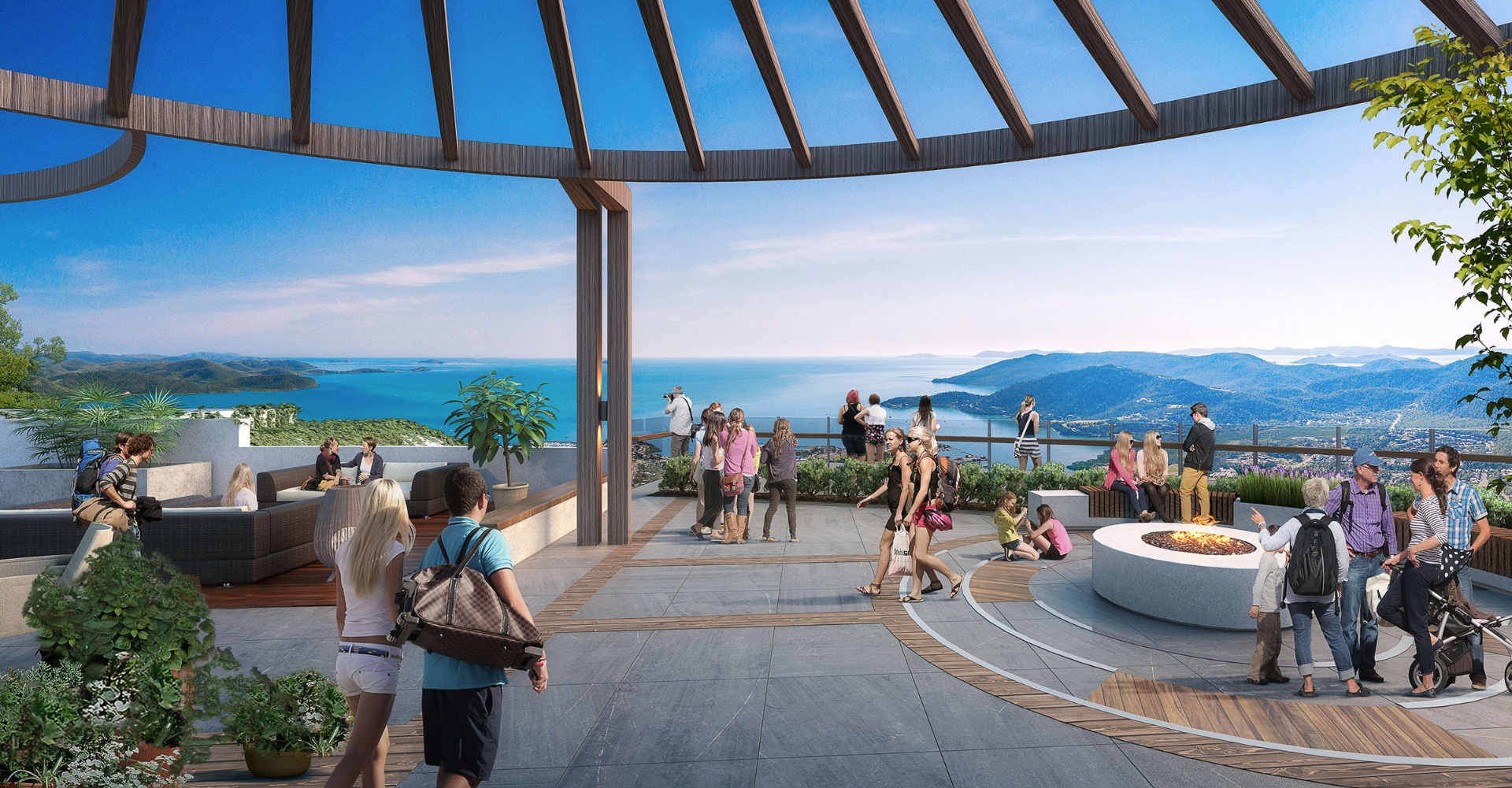
Visualisation of the Whitsunday Skyway summit station.
For developers, the useful way to budget is not to start with a generic gondola price. Start with the transport requirement and the site, then separate the ropeway package from stations, civil works, enabling infrastructure, development costs and contingency.
As a broad external reference, the World Bank has noted that many Latin American urban cable-car systems historically fell in the range of roughly US$10–25 million per kilometre. That is an urban-transit benchmark, not a quotation for tourism projects. Recent individual projects show why a single range can mislead: LEITNER describes the two-section Plose gondola in Italy as part of a EUR 26 million project, while Doppelmayr states that the 8.4 km, six-station Uruapan urban ropeway in Mexico was allocated about US$164 million. Larger multi-station urban projects can be substantially higher.
The right conclusion is not that one system is expensive and another is cheap. It is that scope drives cost.
1. What is included in a gondola construction budget?
A developer should split the project into major cost packages:
- ropeway technology and mechanical/electrical equipment;
- cabins or carriers;
- towers and foundations;
- lower, intermediate and upper stations;
- station buildings and passenger circulation;
- civil and structural works;
- roads, temporary access and construction logistics;
- power supply and utilities;
- land acquisition, leases and easements;
- geotechnical, environmental and planning studies;
- architecture and engineering;
- permits and authority fees;
- testing, commissioning and certification;
- pre-opening recruitment and training;
- visitor facilities such as F&B, retail, viewing areas and attractions — the “second gates”;
- financing costs and contingency.
Manufacturers can price the ropeway system, but the total developer budget is wider than the ropeway supply contract.
2. The biggest cost driver: system type
Technology choice is determined by the operating case, not by which system has the lowest headline price.
A monocable detachable gondola is widely used for tourism and urban applications because it combines continuous boarding with meaningful capacity and relatively efficient infrastructure. More complex systems such as 3S tricable gondolas can offer higher wind stability, longer spans or different capacity characteristics, but generally require a more complex installation.
An aerial tramway operates differently, typically with one or two large cabins shuttling between terminals. It can suit steep or long-span routes, but its station and rope architecture is different from a detachable gondola. The developer should define required capacity, wind performance, span length, evacuation concept, cabin size, operating hours and accessibility before comparing system prices.
3. Stations can dominate the development budget
A tourism ropeway is rarely only a line between two simple terminals.
Stations may need to accommodate ticketing, queuing, toilets, staff areas, maintenance, cabin storage, restaurants, retail, kitchens, event space, viewing terraces, vertical circulation, fire-life-safety systems and back-of-house logistics.
Intermediate stations add cost because they add structures, equipment, land requirements and passenger-flow complexity. In urban projects, stations can also require expensive integration with streets, public transport and surrounding development.
This is why cost per kilometre is often a poor comparison metric. Two ropeways of similar length can have radically different budgets if one has two compact stations and the other has five architecturally complex stations.
4. Terrain and access change civil costs
Mountain and nature-based sites create a different cost profile from urban corridors. Key variables include:
- rock versus soil conditions;
- slope stability;
- foundation requirements;
- tower access;
- helicopter lifts or specialist construction logistics;
- snow and ice loads;
- wind exposure;
- flood, wildfire or seismic requirements;
- protected landscapes;
- distance to grid power and roads.
A short ropeway in an inaccessible site can therefore cost more to build than a longer route with easy construction access.
5. Capacity affects more than cabin count
Higher capacity can require more cabins, larger station machinery, larger queuing areas and more robust passenger circulation. It may also increase parking, transport-interface and visitor-facility requirements.
Developers should size capacity against realistic demand rather than maximum theoretical demand, considering ways to spread visitors across time slots and extract more from a given capacity. Oversizing creates unnecessary capital cost; undersizing can create queues and constrain the commercial upside of a successful attraction.
6. Visitor infrastructure should be budgeted separately
For a point-of-interest attraction, the commercial project often extends beyond the ropeway.
Summit restaurants, retail, event venues, viewing decks, trails and other ancillary attractions may be central to the investment case because they increase dwell time and spend per visitor — the classic second gates. But they should not be hidden inside a generic ‘gondola cost’ assumption.
7. What do real project benchmarks tell developers?
Published examples are useful when their scope is understood.
LEITNER reports that the Plose project in Bressanone, Italy, was a EUR 26 million development. The two-section 10-person gondola totals about 2.64 km and includes 78 cabins, with capacity of up to 2,400 passengers per hour on each section. LEITNER also reports EUR 33 million of total investment in the Voss tourism and transport project in Norway, centred on a 3S gondola and wider destination modernisation.
Doppelmayr states that the government of Michoacán allocated about three billion Mexican pesos, approximately US$164 million at the time of its announcement, for the 8.4 km Uruapan ropeway with six stations. For Mexico City’s planned Cablebus Line 5, Doppelmayr reports a total public investment of 7.9 billion Mexican pesos, approximately EUR 372 million, for 15.2 km and 12 stations. These are not apples-to-apples prices. They are evidence that length alone does not determine cost.
8. Early-stage budget versus tendered cost
Developers should expect the cost estimate to evolve through several stages.
- Concept stage: a broad order-of-magnitude budget based on route, system type, approximate station scope and benchmark projects.
- Feasibility stage: more detailed estimates based on survey, geotechnical data, preliminary engineering, planning requirements and utility needs.
- Design and procurement stage: manufacturer proposals and contractor pricing define the technical and civil packages more precisely.
- Financial close and construction: the budget should include committed contracts, owner costs, financing costs, contingency and escalation exposure.
Treating a concept estimate as a fixed construction price is one of the most common development mistakes.
9. Do not forget contingency and escalation
Ropeway projects combine specialist equipment with conventional construction. Both can be exposed to commodity prices, labour costs, exchange rates, logistics and long procurement lead times.
A development budget should therefore include contingency appropriate to the maturity of design. Early-stage projects need more contingency because route, geotechnical, station and permitting risks remain unresolved.
10. What determines whether the project is economically viable?
Construction cost is only one side of the equation. Developers also need a credible operating model.
The core commercial drivers are annual ridership, average realised ticket yield, ancillary spend per visitor, operating days, staffing, electricity, maintenance, insurance, concession or land costs, marketing and ongoing capital expenditure.
A more expensive project can be the better investment if it serves a stronger destination, has higher pricing power, supports more commercial spend and has a robust operating model. A cheaper system can still fail if demand is weak or the attraction has no route to sustainable EBITDA.
Frequently asked questions
How much does a gondola cost per kilometre?
There is no universal figure. Historical urban-system benchmarks cited by the World Bank have often been around US$10–25 million per kilometre in Latin America, but actual project costs can be lower or much higher depending on station count, technology, terrain, civil works and scope. Tourism projects should be estimated from site-specific design, not from this benchmark alone.
Is an aerial tramway more expensive than a gondola?
Not necessarily in every case. Technology cost depends on span, capacity, wind requirements, station design, terrain and civil works. The system should be selected on operating requirements before cost comparison.
How long does a cable car take to build?
Physical installation can be relatively fast once land, design, permits and contracts are ready. Total development time is usually much longer because feasibility, planning, environmental approvals, land rights, financing and procurement come before construction.
What should a feasibility study include?
At minimum: route options, demand and tourism analysis, system concept, capacity, geotechnical and environmental work, land and permitting review, station concept, preliminary capex and opex, revenue model, delivery strategy, schedule, risk analysis and financial returns.
Can Elevate help with a greenfield ropeway project?
Elevate Collection’s strategy includes ground-up ropeway development alongside acquisition of existing assets. Elevate partners with ropeway developers and manufacturers while bringing investment, project-development and operating expertise to the asset.
Sources used for external benchmarks
World Bank: Urban Aerial Cable Cars as Mass Transit Systems; World Bank transport commentary on cable-car implementation costs; LEITNER project references for Plose and Voss; Doppelmayr project releases for Uruapan and Cablebus Line 5.